
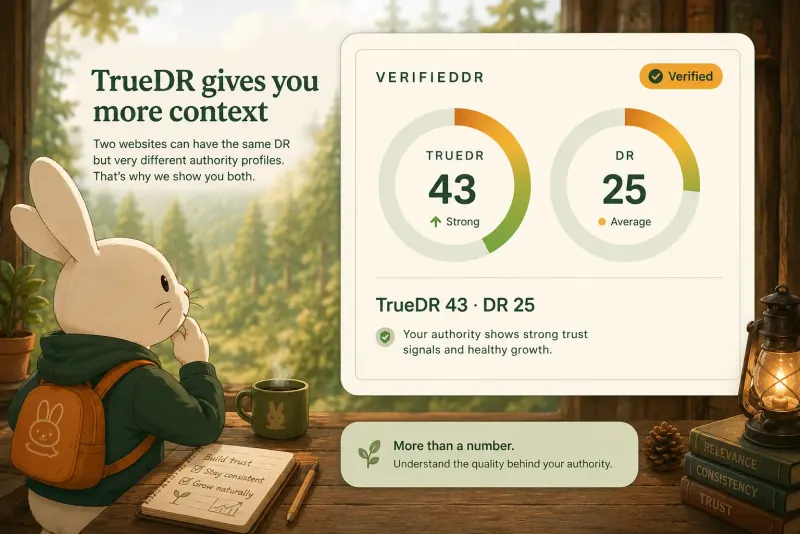
Domain Rating has become the number everyone quotes. Founders trade it in Slack groups, agencies put it on slides, and directories sort by it. Somewhere along the way it collapsed into a single idea: more backlinks equals more visibility.
That shortcut is wrong often enough to be expensive. DR is a logarithmic estimate of how many sites link to you, weighted by how many link to them. It's a decent measure of link volume. It says almost nothing about whether those links were earned, or whether one algorithm update could wipe them out.
- Links earned slowly, over years
- Relevant sites in its own niche
- Real, growing traffic behind it
- Clean spam profile
- Hundreds of links from spam networks in one month
- Off-topic sources, no relevance
- Almost no real visitors
- Trips most spam signals we track
Same DR. Nowhere near the same trust. A single number hides the gap.
The signals DR leaves out
Two profiles with the same DR can differ on every sign of trust:
Quality
Earned mentions from real sites should carry more weight than links from disposable networks.
Relevance
A topical link explains why the recommendation exists. An off-topic link mostly adds noise.
Velocity
Steady growth reads like demand. Sudden spikes often read like manipulation.
Start with link quality. A respected publication gives more trust than a private blog network. Both links can raise DR, but they do not carry the same value.
Topic fit matters too. A link from your field gives useful context. Link growth also matters. Steady growth looks earned. A sudden spike can point to a link scheme.
The website around those links matters too. Domain age gives the count context: a young website with an explosion of links is a very different risk profile than an established one with the same count. Traffic validation is the reality check. Link strength that no real visitors corroborate is fragile. And spam risk sits underneath all of it. Some profiles are one cleanup away from losing most of their DR.
Why this matters more now
Founders want trust in search and AI answers. Both depend on the value of your links, not just the count. A higher count can leave real trust unchanged.
What TrueDR measures
TrueDR checks the trust behind a link score. It weighs link quality, traffic, site age, link growth and spam signs. It is a trust score. It is not a Google rank factor.
TrueDR can rise when trusted links and traffic support a site. Weak links get less weight. You can check any site's TrueDR for free. Site owners can see each check. Here's how TrueDR is built.
TrueDR is now inside BuildHop
This is why we integrated with BuildHop. BuildHop helps founders get discovered by submitting their product to quality directories, which can create the kind of relevant, steady links worth measuring over time. The natural next question is whether those submissions turn into trusted visibility, and that's the part a link count can't answer.
So TrueDR now sits in the BuildHop analytics dashboard, right next to DR. The volume number and the trust-checked number live side by side, on the same screen, for the same website. BuildHop drives the submissions; VerifiedDR shows whether they're translating into trust. Neither of us promises a ranking, and you should be skeptical of anyone who does.
BuildHop wrote up their side of the story too. Read it here.
What to do with this
Choose a few trusted sites that fit your topic. Add links at a steady pace. Then watch TrueDR to see whether those links add trust.
Next reading
Related resources
FAQ
Questions this article answers
Why are some backlinks worth more than others?
Backlinks aren't equal. A site can have the same DR as another site while having much weaker real trust or traffic behind its links.
What does TrueDR measure that DR can miss?
TrueDR weighs backlink quality, domain age, real traffic patterns, and spam risk so inflated DR is easier to spot.
Why is BuildHop relevant to TrueDR?
BuildHop helps founders earn directory backlinks, and the integration shows TrueDR next to DR so founders can see whether those links translate into trusted visibility.
See past the headline number
Check any website's TrueDR for free and find out whether its Domain Rating is backed by real, earned trust.